What Is a Token Factory? Australia's Data Centre Debate Explained
What AI factories and data centres do, and why water, energy, jobs and local trade-offs matter in Australia.
The short version
You may have heard a new phrase in the Australian data-centre debate: token factory.
It sounds like a factory because, in one important sense, that is what an AI data centre does. It takes electricity, computer hardware, cooling, networks and software, then produces computing work. For generative AI services, one visible output of that work is a token: a small unit of text, code or other data used as a model reads a request and generates a response.
The phrase is catchy, but it is not a complete technical category. A token factory is still a data centre, or a specialised part of one. The phrase tells us something about the workload, not everything about the building, the cooling system, the electricity source or the local consequences.
The useful question is not simply “Are token factories good or bad?” It is:
What is this facility being built to do, where will it operate, what resources will it require, and what evidence will let people check the claims?
Why is this suddenly a big Australian story?
Australia already has data centres supporting websites, banking, streaming, cloud storage, research and government services. The newer wave is being driven partly by AI, which needs dense computing equipment to train and run models.
That has created a large pipeline of proposed projects. The Australian Government now says data-centre and AI-infrastructure expansion should be environmentally and socially sustainable, and that the national expectations form part of the industry’s social licence to operate.
State governments are also competing for investment. South Australia has promoted its renewable-energy resources, transmission lines and connectivity while proposing new laws for AI data centres. The opportunity case includes construction, technical work, regional investment and new demand for electricity. The questions include water, land, grid capacity, household costs and who pays for new infrastructure.
Tasmania has become a particularly visible example. Firmus Technologies is building an AI factory at St Leonards and has proposed facilities at Bell Bay and Wesley Vale. ABC reporting has described community concerns about electricity, water, noise and the benefits that Tasmania would receive.
In July 2026, ABC reported that an internal Firmus document had noted the company would “likely use Tas Irrigation, but we do not want to highlight this yet, as they are yet to agree to supply us, as we fall outside their normal customer base [agriculture].” The reference was removed from the company’s public FAQ after it was questioned. Tasmanian Irrigation said it had made no undertaking to supply the company and that its legislative framework is focused on agriculture and hydrogen production. That is a report about a proposal and a public dispute, not proof that every Tasmanian project will use irrigation water.
It is a good example of why the details matter.
What is inside a token factory?
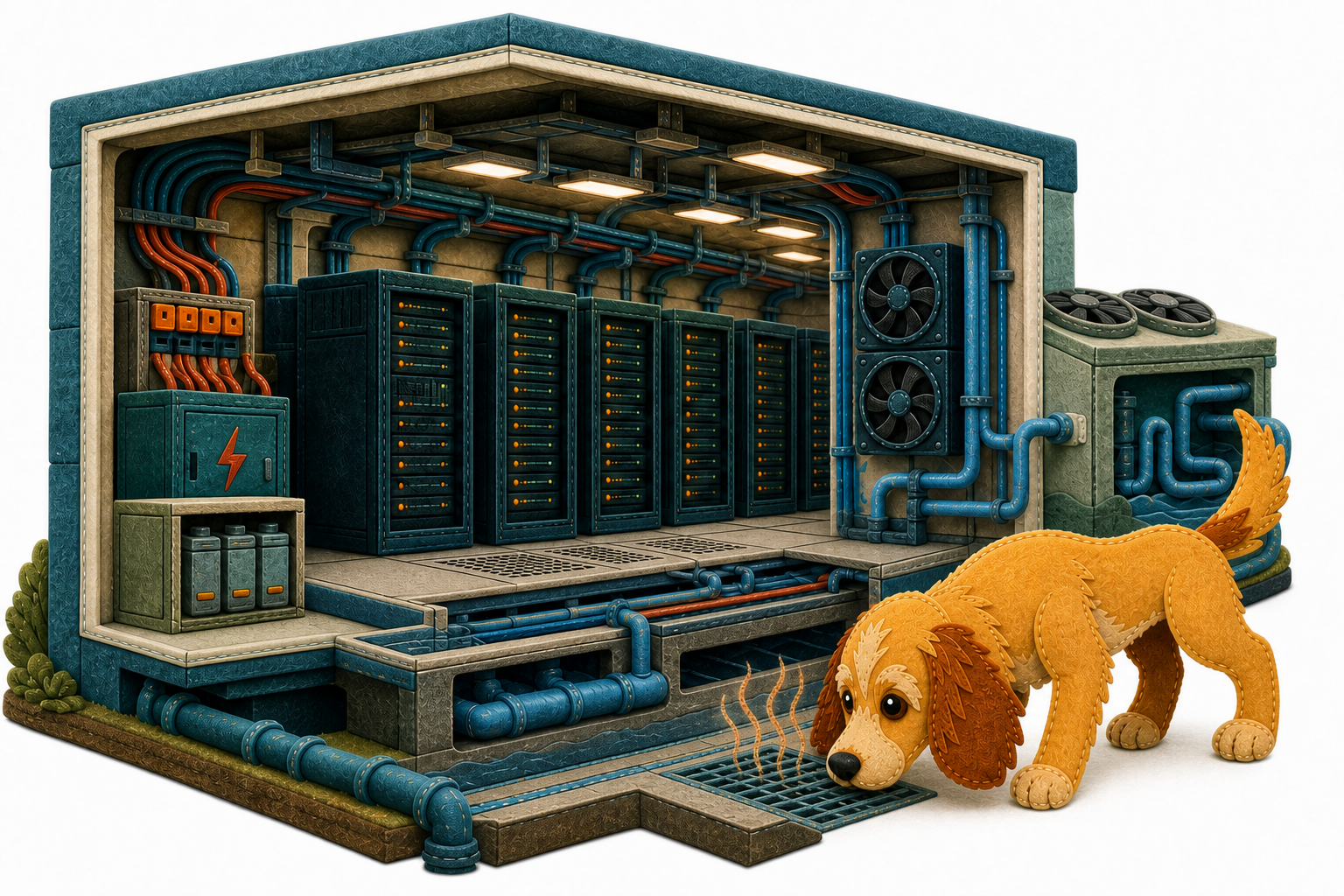
At a simple level, an AI data centre contains:
- server racks containing processors and memory;
- networks that move data between machines and out to users;
- power-delivery equipment and backup systems;
- cooling equipment that moves heat away from the chips;
- monitoring, security and fire-safety systems;
- buildings, roads, cables, water connections and other infrastructure.
The servers do not float in “the cloud”. They sit in physical buildings connected to physical networks and energy systems. When the computing workload becomes denser, more electricity is used in a smaller area and more heat needs to be moved.
That heat has two stages. First, it moves away from the chips and racks. Then the facility rejects it outdoors. A system might use room air, rack-level cooling, direct liquid cooling, dry heat rejection, evaporative cooling or a hybrid of these. “Water cooling” is too vague to tell us which arrangement is being used.
The water question is real, but one number is not enough
Data centres can use water directly for cooling. They can also be connected to water and wastewater infrastructure, and their electricity supply has its own resource story. Some facilities use air cooling for much of the year and add evaporative cooling during hotter conditions. Others use closed loops or recycled and non-potable water.
This means two statements can both be true:
- a particular facility may use very little fresh water for much of the year;
- a large group of facilities can still create a material demand on a local water system.
ABC has reported that Firmus expects dry cooling to reduce water use at its proposed Tasmanian sites, while also reporting the company’s requested allocations and the different figures discussed for planned facilities. Dry cooling can reduce on-site water use, but it can require more electricity to move the same heat under some conditions.
The source matters too. Potable drinking water, recycled water, captured rainwater and industrial water are not interchangeable in a drought, a regulated catchment or a community budget. A claim about “water use” should tell us which source, which site, which period and which measurement boundary it means.
The energy question is not just “renewable or not”
AI data centres can run continuously and require a dependable electricity supply. A developer may buy renewable electricity, support new generation, use storage, or make other commitments. Those are important details, but they do not automatically answer every question about timing, transmission, backup supply or local grid constraints.
Australia’s energy forecasts are scenarios, not a single guaranteed future. ABC reported on a high-growth scenario from a Greenpeace-commissioned analysis, using government projections, in which data centres could rise from about 2 per cent of national electricity use in 2024–25 to 13 per cent in 2040. The article also reported that the projected additional load by 2030 was comparable to Tasmania’s current demand.
Those figures should not be read as a prediction that every proposed project will be built. They show why planners, communities and energy users are asking how quickly demand might arrive and who will fund the generation, storage and network upgrades needed to meet it.
NABERS provides one useful Australian measurement tool. Its data-centre ratings use actual operational data and Power Usage Effectiveness, or PUE, to indicate energy efficiency. A rating can help compare facilities, but it does not answer every question about total emissions, water scarcity, the usefulness of the computing work or whether a project is appropriate in a particular place.
What might communities receive?
The opportunity case for a token factory can include construction work, technical jobs, local contracts, research partnerships, improved connections and tax or economic activity. Some of those benefits may be substantial. Some may be temporary. Some depend on skills, ownership, procurement and the final operating model.
That is why “jobs” should be a question, not a conclusion. How many jobs are expected during construction? How many remain once the facility is operating? What skills are required? How many workers will be local? What training or community infrastructure is included?
Communities may also experience costs or changes: new buildings and roads, noise, backup generators, land-use pressure, water demand, grid upgrades, visual impact or a different claim on regional resources. The fair comparison is not a simple list of benefits against a simple list of harms. It is a request for the full design, the assumptions and the commitments to be made visible.
What should we ask before believing a claim?
When you see a dramatic data-centre number, ask:
- Is it actual use, a design capacity, a requested allocation or a forecast?
- Is it for one facility, a proposed cluster, a city, a state or Australia as a whole?
- Does “water” mean on-site cooling water, drinking water, recycled water, wastewater or a wider indirect estimate?
- Does “energy” mean the computing equipment only, the whole facility, or additional generation and network capacity?
- Which cooling system is being used, and what happens on a very hot day?
- What will be measured after the facility opens, and will the results be published?
- Who pays for new roads, power, water, wastewater and other infrastructure?
- What benefit remains for the local community after construction is finished?
A balanced conclusion
Data centres are not weightless clouds. They are industrial infrastructure with computers inside, and AI workloads can make their electricity demand, heat density and cooling requirements more significant.
It is also too simple to treat every data centre as identical. A facility’s impact depends on its workload, location, climate, cooling design, electricity supply, water source, operating efficiency, construction and reporting boundaries.
The most responsible position is therefore not “token factories are harmless” or “token factories are automatically destructive”. It is that large proposals should explain their resource requirements clearly, pay their fair share of infrastructure, consult affected communities and publish enough operational evidence for their claims to be checked.
The debate is still moving. That makes careful questions more useful than viral certainty.
What this article does not cover
This article focuses on physical infrastructure, water, energy and local trade-offs. It does not attempt to settle data sovereignty, foreign ownership, where Australians’ data is legally stored or how national-security rules should apply. Those questions deserve their own article, with their own definitions and evidence trail.
Evidence Trail
What this article is based on
Australian Government Department of Industry, Science and Resources. Expectations of data centres and AI infrastructure developers. 23 March 2026; checked 29 July 2026
Sets national expectations that data-centre and AI-infrastructure growth should be environmentally and socially sustainable, with proposals assessed against national interests.
ABC News. Artificial intelligence company Firmus plans to use state-owned agricultural irrigation water. 22 July 2026; checked 29 July 2026
Reports Firmus's proposed Tasmanian AI factories, the deleted FAQ note about possible irrigation-water use, and Tasmanian Irrigation's statement that it has made no undertaking to supply the company.
ABC News. Facing public backlash in Tasmania, Firmus moves to calm concerns about its AI data centres. 2 July 2026; checked 29 July 2026
Reports proposed water allocations, dry-cooling trade-offs, renewable-power commitments, projected electricity demand and community questions about benefits and impacts.
ABC News. SA government moves to regulate AI data centres as water, energy concerns mount. 23 June 2026; checked 29 July 2026
Describes South Australia's proposed strategy and legislation, opportunity claims, water and energy concerns, and questions about who pays for infrastructure.
ABC News. Report warns AI data centre boom threatens Australia's energy transition. 27 May 2026; checked 29 July 2026
Reports a Greenpeace-commissioned analysis using government projections and the uncertainty around high-growth electricity-demand scenarios.
ABC News. What are data centres and what do they mean for regional Victoria?. 5 February 2026; checked 29 July 2026
Explains the physical infrastructure, cooling choices, regional-development arguments and the relationship between energy, heat and water.
NABERS. NABERS for Data Centres. Current page; checked 29 July 2026
Explains Australia's operational energy-efficiency rating framework, based on actual facility data and PUE.
Infrastructure Australia. Water supply. 2026 Infrastructure Priority List; checked 29 July 2026
Describes Australian water-supply pressures, recycled water, desalination and regional water-security constraints.
Limitations
Token factory is a recent industry term rather than a universally agreed technical category. Project proposals, water allocations, energy forecasts and facility designs can change. National totals do not establish the impact of a particular site. The primary reporting for Australian developments relies substantially on ABC News coverage; primary data from company filings, government impact assessments and independent audits was not separately obtained for this article.
Review date: 29 July 2026